Photography Research Project

Ansel Adams

Master of the American landscape, pioneer of the Zone System,and tireless advocate for wilderness preservation

Explore the Research

Section One

Research Log

Key Findings

  • Adams was born in San Francisco in 1902 and first visited Yosemite National Park at age 14. That trip shaped the rest of his life. His parents gave him a Kodak No. 1 Box Brownie camera during the visit, and he never really put a camera down after that.
  • He originally trained as a concert pianist and spent years torn between music and photography before fully committing to the camera in his late twenties. His musical background fed directly into how he talked about his craft: the negative was a “score,” the print was a “performance.”
  • Together with Fred Archer, Adams developed the Zone System around 1939-40. It is a technical framework for controlling exposure and development to get precise tonal values in black-and-white prints. The system breaks the tonal range into eleven zones, from pure black to pure white.
  • Adams co-founded Group f/64 in 1932 alongside Edward Weston, Imogen Cunningham, and others. The group pushed “straight photography” (sharp focus, full tonal range, no manipulation) as a direct rejection of the soft-focus Pictorialist movement that dominated art photography at the time.
  • Adams served on the board of the Sierra Club for 37 years and used his photographs as advocacy tools for environmental conservation. His images of the American West played a real role in expanding the national park system.
  • Adams received the Presidential Medal of Freedom in 1980 from Jimmy Carter. The citation praised him as “at one with the power of the American landscape” and “visionary in his efforts to preserve this country’s wild and scenic areas, both in film and on Earth.” He died in 1984.

Direct Quotes

By the photographer

“A great photograph is one that fully expresses what one feels, in the deepest sense, about what is being photographed.”

- Ansel Adams, from Ansel Adams: An Autobiography (1985)

About the photographer

“Adams did not photograph the landscape as a matter of social service, but as a form of private worship. It was his own soul that he was trying to save.”

- John Szarkowski, Ansel Adams at 100 (2001)

From a critic / scholar

“For what is this perfectionism about, if not the desire to refine and perpetuate a sense of paradise that continually slips away, recorded only in silver particles and the memory of old men?”

- Robert Hughes, “Master of the Yosemite,” Time, September 3, 1979

Source Trail

  • Started with the Ansel Adams Gallery website for biographical basics, then moved to his published autobiography for firsthand accounts
  • Found the Szarkowski quote in Ansel Adams at 100, a MoMA exhibition catalog published in 2001
  • Tracked down the Robert Hughes review through Timemagazine’s historical archive
  • Cross-referenced Zone System details with Adams’s own technical manual, The Negative, and secondary descriptions in Beaumont Newhall’s The History of Photography
  • Confirmed Group f/64 founding details through the San Francisco Museum of Modern Art’s online collection records

Why These Details Matter

Understanding Adams means keeping two things in mind at once: his technical precision and his emotional connection to the land. The Zone System was not just a way to expose film. It was how he turned feeling into light and shadow, how he made a print carry the same weight he felt standing in front of a mountain. His environmental work was not a side interest, either. It ran through everything he did. Every sharp ridge and bright cloud in his photographs was, quietly and stubbornly, an argument that these places were worth protecting. Pulling these threads together changed how I see Adams. He went from “the guy who took pretty nature photos” to someone who spent his whole life trying to see things clearly and make other people care about what he saw.

Section Two

Image Set & Annotations

All photographs below are sourced from Wikimedia Commons and are in the public domain.

Monolith, the Face of Half Dome

Monolith, the Face of Half Dome

1927

Gelatin silver print; Korona view camera with glass plate negative

Wikimedia Commons (public domain)

Half Dome fills the frame against a near-black sky, all raw geological weight. Adams later said this was his first real act of "visualization." He consciously chose a deep red filter to darken the sky and push the drama of the rock face, instead of just recording what was in front of him. The contrast between the bright granite and the dark sky gives the image a monumental, almost religious quality. I picked this photograph because it marks the moment Adams went from taking pictures to making them. It also shows something he believed for the rest of his career: that the photographer's emotional response to a scene should drive every technical choice.

Clearing Winter Storm, Yosemite National Park

Clearing Winter Storm, Yosemite National Park

c. 1937-1944 (date disputed)

Gelatin silver print; 8x10 view camera

Museum of Modern Art, New York / Wikimedia Commons

Clouds sweep across Yosemite Valley in layers, half-hiding the granite walls while shafts of light break through to hit Bridalveil Fall and the valley floor. There is darkness in the foreground, brightness in the middle, and a moody ceiling of cloud and cliff on top. I picked this photograph because it shows Adams's ability to capture weather that was changing by the minute using a slow, heavy large-format camera. It says something about his patience: he was willing to wait for hours, or come back across multiple trips, for the light to line up.
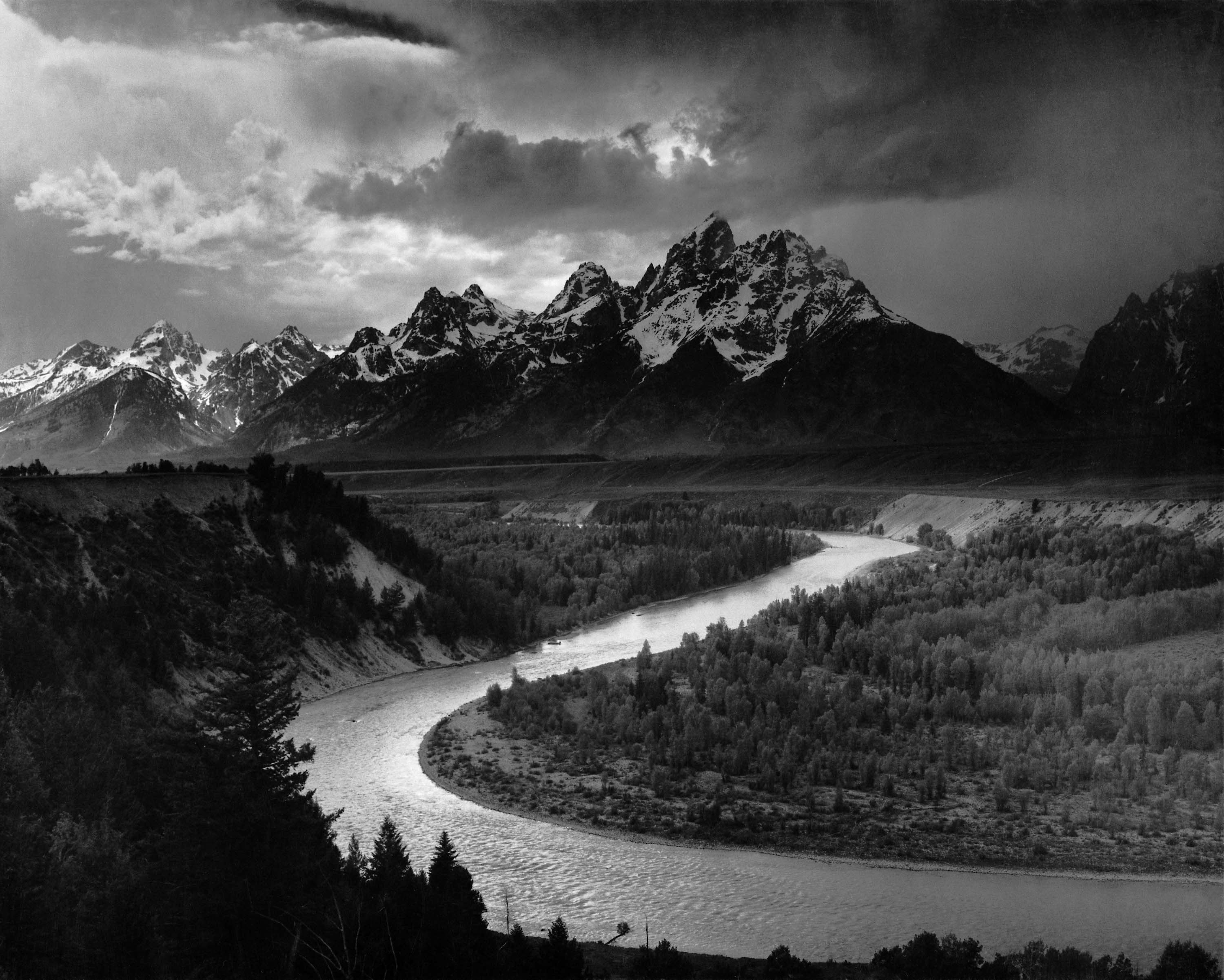
The Tetons and the Snake River

The Tetons and the Snake River

1942

Gelatin silver print; 8x10 large-format view camera

National Archives and Records Administration

The Snake River curves through the frame in a big S-shape, pulling your eye from the cottonwoods in the foreground up through the valley to the jagged Tetons on the horizon. Storm clouds pile up behind the peaks. This might be Adams's most deliberately composed image. The river works like a textbook leading line, but somehow it does not feel forced. I included it because it shows his ability to find structure in wild places, and because it was one of the 116 images placed on the Voyager Golden Record and launched into space as a picture of life on Earth.

Portrait of the Photographer
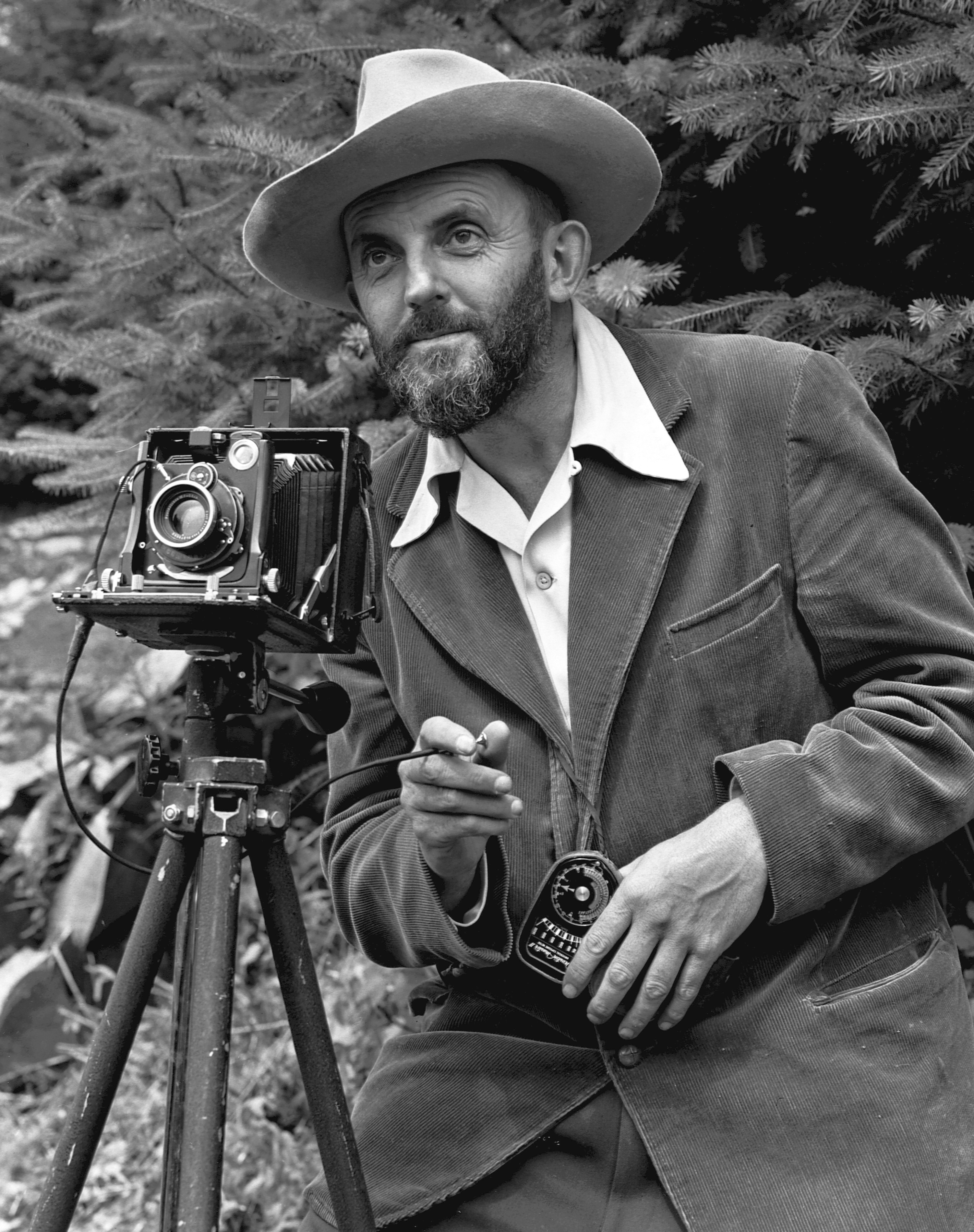
Portrait of Ansel Adams with his camera

Ansel Adams with his camera on a platform overlooking a landscape

Photograph by J. Malcolm Greany, c. 1950

Source: Library of Congress / Wikimedia Commons

Section Three

Source Evaluations

Autobiography / Book

Ansel Adams: An Autobiography

This is Adams’s own account of his life, published after his death in 1985 with help from Mary Street Alinder. As a primary source, it gets you pretty close to how Adams actually thought about his work: what drove him, what frustrated him, and how he saw photography as a creative act. He’s surprisingly honest about his early indecision between music and photography, and the writing is clear even if he can be a bit self-congratulatory at times. It’s reliable for personal recollections, but it carries the usual memoir bias: Adams is telling his own story the way he wants it told. The most useful thing I got from this source was his description of “visualization”: basically, seeing the finished print in your head before you press the shutter. That idea really changed how I understood his work. His photographs weren’t lucky shots. They were planned acts of translation, from a three-dimensional experience to a flat print.

Critical biography / Book

Looking at Ansel Adams: The Photographs and the Man by Andrea G. Stillman

Stillman actually worked as Adams’s personal assistant toward the end of his life, so she has an insider’s view but still writes with real scholarly care. The book puts reproductions of key photographs next to detailed discussions of their context: when they were made, why Adams kept going back to the same spots, and how he printed and reprinted images over decades. It’s a solid secondary source with the bonus of firsthand access to Adams’s archive. The thing I found most useful was her discussion of how Adams’s printing style changed over the years. His later prints of the same negatives are way darker and more contrasty than the earlier versions, which tells you his “vision” of a scene kept evolving long after he took the picture. That messed with my assumption that his photographs were fixed, done-in-one-moment things.

Survey / Academic text

The History of Photography: From 1839 to the Present by Beaumont Newhall

Newhall’s survey is one of those books that shows up on every photo history syllabus, and his section on Adams falls in the bigger chapter on modernism and straight photography in America. It’s a reliable academic source, though Adams only gets about eight pages out of a 300-page book, so you’re not getting a deep dive. What made it really useful for this project was the context. Newhall puts Adams next to people like Edward Weston and Paul Strand, and once you see them together it’s clear that Adams’s technical obsessions weren’t just personal quirks. They were part of a bigger push to get photography recognized as its own art form, separate from painting. The detail that stuck with me was Newhall mentioning that Adams printed “Moonrise, Hernandez, New Mexico” over 1,300 times during his career, each one a little different. That kind of thing tells you everything about how he saw the darkroom: not as a processing lab, but as a creative workspace.

Section Four

Critical Reflection

Ansel Adams is one of the most known photographers in the entire world. Even people who don't know a single thing about photographers have heard his name one or twice somewhere. He is also one of the most influential photographers in the world. I chose him because I was curious how a photographer could have such a lasting impact on _both_ art and photography. Before I began my research, I knew for a fact that Adams was famous for having black and white photographs, but I did not understand why people still admired them. I figured that since it has been a long time since he was active, people would have moved on to more modern/modernized art.

One of the most surprising things I learned about Adams was the amount of effort he put into the technical part of his pictures. A lot of people who didn't pursue photography professionally think of the subject as something where you just take pictures and that's it. Adams treated it as both science and art. He developed the Zone System, a way photographers controlled exposure and contrast much more efficiently. His photos were not just shots, but carefully planned and executed technically. I was also surprised to know that Adams spent a long time, sometimes hours, waiting for the perfect lighting to take his picture.

Adams was also very dedicated to protecting nature. He used his photographs to advocate for environmental protection. He took photographs of wilderness such as Yosemite National Park and helped people appreciate the beauty of the country's natural landscapes. His images encouraged support for environmental conservation and influenced general public opinion about preserving nature and national parks. This made me realize that photography can do things other than artistic expression, it can also inspire social and environmental change.

Ansel Adam's work also fits into the broader history of photography because he helped bring photography to the level of the fine arts. In the early 20th century, many people did not consider photography to be as valuable as art (painting/drawing) or sculpting. Photography was also not as advanced as it is now. Adams showed that photographs could be carefully composed and powerful works of art emotionally. His success helped increase respect for photography and had people consider it an artistic medium. He also helped influence generations of photographers who used his techniques and standards for image quality.

Section Five

Bibliography

Chicago Manual of Style, 17th Edition

Adams, Ansel. Ansel Adams: An Autobiography. Boston: Little, Brown and Company, 1985.

Adams, Ansel. The Negative. The Ansel Adams Photography Series, Book 2. Boston: New York Graphic Society, 1981.

Hughes, Robert. “Master of the Yosemite.” Time, September 3, 1979.

Newhall, Beaumont. The History of Photography: From 1839 to the Present. 5th ed. New York: Museum of Modern Art, 1982.

Stillman, Andrea G. Looking at Ansel Adams: The Photographs and the Man. Boston: Little, Brown and Company, 2012.

Szarkowski, John. Ansel Adams at 100. Boston: Little, Brown and Company, 2001.

Section Six

AI Use Log

Platform Used

Claude (Anthropic). Used for website development, CSS styling, and layout structure.

Prompts Entered

  • Prompted Claude to help build a Next.js website to present the research project, including layout, styling, and section structure.
  • Asked Claude to write and adjust the CSS (colors, typography, scroll animations, responsive layout).

What Part of the Assignment It Supported

AI was used only for the technical side of building the website: HTML structure, CSS styling, React components, and scroll animations. The AI did not do the research, pick the images, write the reflection, or evaluate sources. All written content and analysis is my own work.

How the Output Was Revised

The generated website code was reviewed for accuracy, adjusted for visual consistency, and modified to ensure all content matched the research I conducted independently. Layout decisions, color choices, and typographic hierarchy were refined based on personal preference rather than accepting defaults.